
Online Safety at Stapleford
Keeping Children Safe Online
The internet and digital technology provide wonderful opportunities for children to learn, create, communicate and explore. We want our children to enjoy these opportunities while developing the knowledge and confidence they need to make safe, kind and responsible choices online.
At Stapleford Community Primary School and Nursery, online safety is an important part of safeguarding and is woven through our curriculum and wider school life. Children learn about online safety through Computing, PSHE and Relationships Education, assemblies and themed safeguarding work. We also respond to emerging issues and things that are relevant to the children in our school.
Our teaching develops as children move through school. It includes keeping personal information safe, communicating respectfully, recognising inappropriate content or contact, cyberbullying, digital footprints, critical thinking and knowing what to do and who to tell if something online makes them worried or uncomfortable. Children also learn that images, information and profiles they encounter online may not always be genuine, including content that has been created or altered using artificial intelligence.
Be SMART, Show CARE
We link online safety closely to our CARE values: Curiosity, Ambition, Resilience and Excellence, alongside the SMART rules children use to help them make safe choices online.
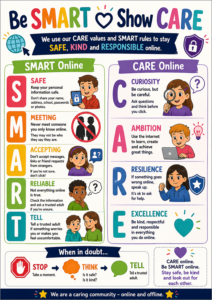
The poster gives children simple messages they can remember wherever they are using technology:
S – Safe: Keep personal information safe.
M – Meeting: Never arrange to meet somebody you only know online.
A – Accepting: Be careful about accepting messages, links or requests.
R – Reliable: Remember that not everything you see online is true.
T – Tell: Tell a trusted adult if something worries you or makes you uncomfortable.
Alongside these rules, our CARE values remind children to be curious but careful, use technology positively, ask for help when something goes wrong, and treat others with kindness and respect.
STOP. THINK. TELL.
If something doesn’t seem right, we encourage children to stop, think and tell a trusted adult.
How we keep children safe in school
Online safety is reinforced throughout the year rather than being limited to a single event or lesson. Safer Internet Day provides an additional opportunity to explore important themes, alongside our regular curriculum, assemblies and responsive teaching.
Our Trust provides filtering and monitoring systems across school internet-connected devices as part of our wider safeguarding arrangements. Staff receive annual and ongoing online-safety training, including emerging risks and their responsibilities for filtering, monitoring and reporting concerns.
Our SMART and CARE messages are displayed around school and on the trolleys where devices are stored, providing children with regular reminders whenever they use technology.
Stapleford is also a mobile-phone-free school by default. Where a pupil has permission to bring a mobile phone or smart device to school, it must be switched off on arrival and handed to the school office for secure storage during the school day.
Working together with parents and carers
Children’s online lives do not stop when they leave school, so working together with families is an important part of keeping children safe.
We encourage parents and carers to stay interested and involved in what children are doing online. Talk about the games they play, the videos they watch, the apps they use and the people they communicate with. Creating an environment where children know they can tell an adult when something has gone wrong is one of the most important things we can do.
Our school guidance encourages families to talk regularly about children’s online experiences, establish appropriate boundaries around devices and screen use, and model positive, respectful digital behaviour.
Some simple things you can do at home
- Talk regularly about what your child enjoys doing online.
- Explore together. Take an interest in the games, apps and platforms your child uses.
- Check age restrictions and parental settings on games, apps and services your child wants to use.
- Talk about personal information and what should and shouldn’t be shared online.
- Talk about kindness online. The same expectations for how we treat others apply online and offline.
- Encourage critical thinking. Help children understand that not everything they see, hear or read online is necessarily reliable.
- Keep communication open. Reassure your child that they can tell you if they see something upsetting, make a mistake or something goes wrong.
- Reinforce our simple message: STOP. THINK. TELL.
Keeping you informed
Online risks and children’s interests change quickly. We therefore share information with parents and carers through our fortnightly newsletter and other parent communications when particular games, apps, online behaviours or emerging issues are relevant to our children.
Below you will also find a growing collection of parent information guides and leaflets. These focus particularly on the apps, games, platforms and online behaviours that children are talking about or encountering.
Downloads
SCPS Use of Mobile Phones and Smart Devices Policy
SCPS Online Safety Policy
10 Essential Online Safety Tips
Digital Wellbeing Resource Guide
Parental Controls Booklet
What Parents Need to Know about Whatsapp
National Online Safety Guide to Tiktok
National Online Safety Guide to Memes
National Online Safety Guide to Group Chats
National Online Safety Guide to Streamers
National Online Safety Guide to Roblox
The FOSI Guide to Roblox
National Online Safety Guide to Fortnite
National Online Safety Guide to in-game chat
Childnet Cheat Sheet to genai
Childnet Cheat Sheet to Group Chats